


Art Basel Paris 2026: Art Under Glass, Unrest at the Door
The fifth edition of Art Basel Paris was meant to be a celebration: 211 galleries, a new director and the light of the Grand Palais' great glass roof. After last week's riots and with new protests announced, the fair now closes two days early. A walk between record prices, security barriers and an art world asking itself who really tells its stories.
Farewell after a single public day
Since Thursday afternoon it has been official: Art Basel Paris concludes its 2026 edition on Friday, 23 October, at 7 p.m. The Grand Palais stays closed on Saturday and Sunday. The message to guests and galleries said the fair would close "in light of potential demonstrations across Paris this weekend, and in the interest of safeguarding our visitors, exhibitors, partners, staff and artworks" (The Art Newspaper). It added: "This decision has not been taken lightly, and the safety of everyone involved in the fair remains our utmost priority" (The Art Newspaper).
The email to galleries was signed by Vincenzo de Bellis, Art Basel's chief artistic officer, and Karim Crippa, director of Art Basel Paris (Artsy). They asked galleries to keep their booths intact until Friday evening and not to begin deinstallation before official instructions (Libération). The organisers acted without waiting for a decision from the police prefecture (Le Figaro).
That leaves the general public a single day. After the Avant-Première, two preview days and the vernissage, Friday is both opening and finale (Artsy).
What happened outside the Grand Palais
The backdrop is a wave of protest that has gripped France for weeks. It began with students frustrated by conditions in their schools and was joined by groups protesting the rising cost of living. On the weekend of 17 October it tipped into some of the most severe riots the country has seen in decades (The New York Times). At least 2,500 people were arrested across France (The Art Newspaper). On the Champs-Élysées, a few steps from the Grand Palais, numerous shops were damaged (PNP/dpa). On Saturday evening the Paris police prefecture temporarily closed the Grand Palais as a precaution (watson).
Two factors tipped the balance. A new major day of protest is planned for Saturday, 24 October. And a call to "take the Palais" at 4 p.m. on Saturday circulated widely on social media (Beaux Arts Magazine). According to Le Figaro, it came from the Instagram account "Documentations-art", which vowed to fight the art world's "hegemonic and conservative discourse"; the post drew thousands of likes and comments.
The situation according to the police prefecture
The official orders of the Préfecture de Police show how tight the security framework was this week. Its register of decrees for October lists night-time curfews, a ban on certain demonstrations and bans on protective equipment and weapons around schools and universities in Paris and the surrounding départements. For Thursday, the police prefect also issued a perimeter order banning gatherings and demonstrations in certain sectors of Paris from 8 a.m. to 8 p.m., as the prefecture announced on X. The zones included the area around the Élysée and the Champs-Élysées, the very district of the Grand Palais (La Croix).
For Saturday, the prefecture approved a union march, led among others by the CGT, between Bastille and Nation, while the route from Bastille to Opéra declared by the student collective Interfac and several gilets jaunes will be banned (Le Figaro). With decree no. 2026-01415, the prefecture also banned three declared static gatherings on Avenue Gabriel near the Élysée Palace (Sortir à Paris). At the prefecture's request, 24 metro stations will close on Saturday, from the Champs-Élysées to the Latin Quarter (Sortir à Paris). President Emmanuel Macron said only union marches on routes protecting shops and public buildings would be allowed on Saturday (L'Indépendant).
Art Basel is not alone. The Louvre, Musée d'Orsay and Musée Picasso close on Saturday (actu.fr), as does the Fondation Louis Vuitton (Artforum). The Foreign Ministry postponed "Passages — Pas sages" by Thierry Lemaire and Harry Nuriev, and Guerlain on the Champs-Élysées cancelled its opening cocktail for the Shalimar centenary (WWD).

The fair as it was planned
According to Art Basel's official press dossier, the fifth edition brings together 211 galleries from 41 countries and territories: 183 in the main Galeries sector, 16 solo presentations in Emergence and 12 art-historical projects in Premise. 64 exhibitors operate spaces in France, 32 galleries take part for the first time, and a record 12 joint booths bring together 24 galleries (Art Basel Press).
It is the first edition under Karim Crippa, previously the fair's director of communications (Art Basel). New this year: the larger Salon Seine for Premise, an additional entrance via Square Jean Perrin, and the Conversations talks in the Grand Palais Auditorium (Art Basel). Premise is one of the few Art Basel sectors allowed to show works made before 1900; highlights include Sibylle Ruppert with Zurich's Blue Velvet, Derek Jarman, Tarsila do Amaral and Futura (Art Basel).
The closure hits one format that made the Paris fair unique particularly hard: "Oh La La!", the Friday and Saturday rehang, art-directed this year by actress Philippine Leroy-Beaulieu around the theme "Myths and Legends" (Art Basel Press). With Saturday gone, it loses its second half.
A walk in pictures
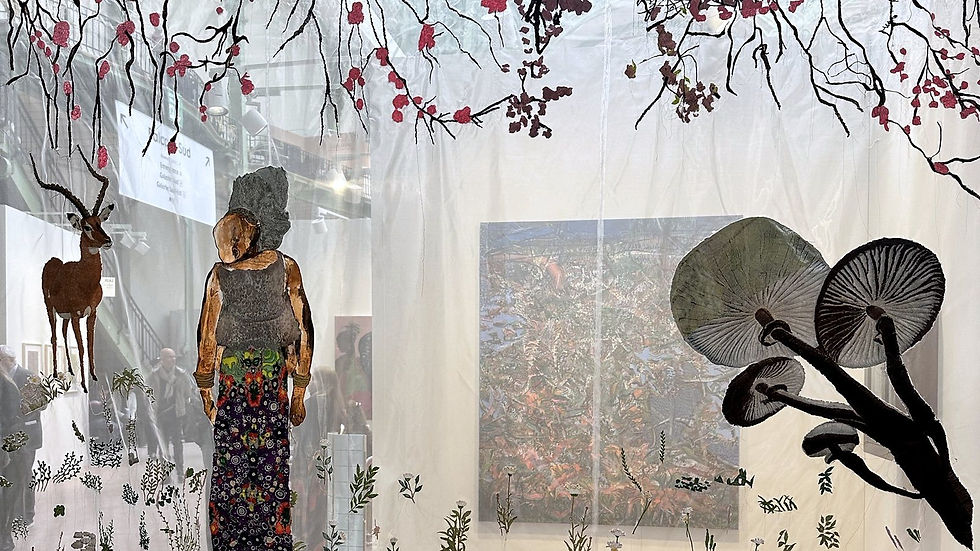
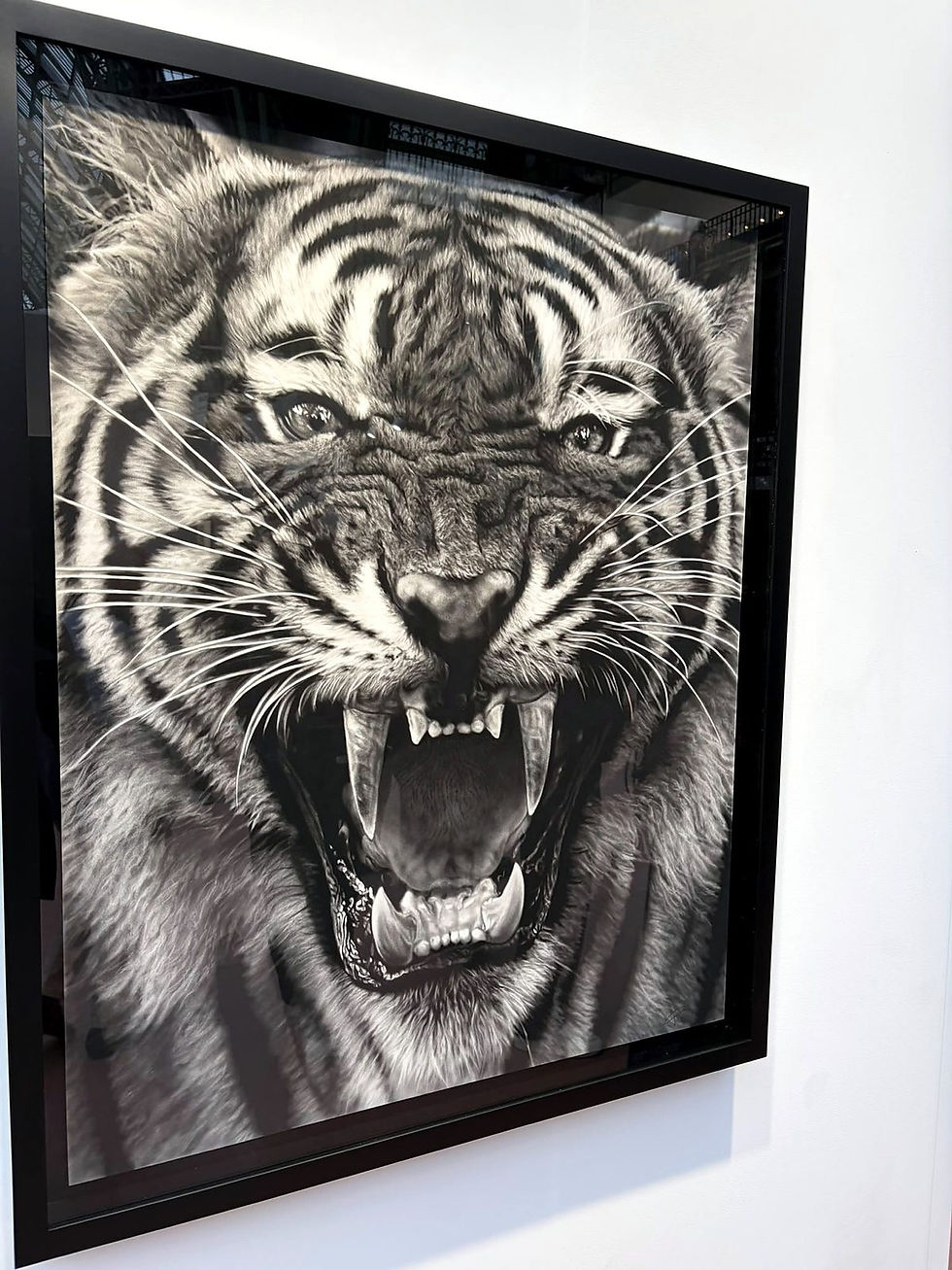
Walking through the nave this week, one saw a fair that answered the mood outside with sensuality. Several booths played with the body, reflection and the plant world.


A dialogue of form and colour at the Tina Kim Gallery booth: a looped sculpture stands before a large pink painting covered in script.


Humour was not in short supply. A sheet with two orange torch lilies carries the handwritten confession "I own seven pairs of underwear and seven pairs of socks. All identical."


Two busts after classical models, one white with black dots, the other flesh-toned with exaggerated breasts and red lips, comment on ideals of beauty from antiquity to Instagram.


At Regen Projects from Los Angeles hangs Jack Pierson's wall work "FAMOUS LAST WORDS" (2026) in metal and wood (Daily Art Fair). This week, the title inevitably reads twice.


The classics
In the modern section Picasso dominated, among others with a mother-and-child scene and a man's head from 1965. Alongside: a bronze bust by Alberto Giacometti with a rugged surface and a painting signed and dated 1947 by CoBrA co-founder Karel Appel.


The market: fast, safe, expensive
The contrast between street and booth is striking. While barriers stood outside, works sold quickly inside in the first hours. According to the Observer, Hauser & Wirth sold Gerhard Richter's "Rokokotisch" (1965) for around $10 million and Georg Baselitz's "Der Hirte" (1965) for $10 million. David Zwirner reported a Richter painting at $8.5 million, a 1957 Joan Mitchell at $3.8 million and a new Marlene Dumas at $3 million. White Cube sold two Julie Mehretu canvases at $7.85 million each and a Tracey Emin for £990,000 (Observer). P.P.O.W. sold Martin Wong's four-metre painting "La Iglesia de Dios" (1986) for $1.75 million to an American institution (ARTnews).
The tone behind it is cautious. Paris advisor Sascha Zerbib summed it up: collectors want reassurance, are willing to raise budgets, but demand pedigree and established works (Observer). Thaddaeus Ropac spoke of a very strong opening afternoon, although concerns about demonstrations had kept some collectors from travelling (Observer). For New York advisor Adam Green, Paris is now American collectors' favourite fair of the year, and the protests did not keep them away (Observer).
Who pays the price
The shortened fair does not affect everyone equally. As Le Figaro calculates, exhibitors are left with four selling days instead of six and the fair loses two days of ticket sales. Viennese dealer Emanuel Layr considers the closure the right decision but warns that small and mid-sized galleries will suffer, since many of their collectors work during the week and only come at the weekend (ARTnews). A smaller gallery said many visitors never reached the Emergence sector on the upper balconies during the previews and would have come at the weekend (ARTnews).
Wendy Olsoff of P.P.O.W. recalled those rarely seen: service staff losing shifts, taxi drivers and restaurants that depend on fair crowds (ARTnews). Whether there will be compensation remains open. An Art Basel spokesperson said it was "too early to comment on any financial or contractual implications" and that the fair remained in direct contact with its galleries (ARTnews).
Deinstallation against the clock
Now the logistics begin. Galleries may bring crates into the Grand Palais after Friday's close; no one is allowed in on Saturday, and packing may resume on Sunday depending on conditions (ARTnews). Galerie Mennour planned to remove the sculptures by Alicja Kwade and Yinka Shonibare on the closed avenue between the Grand and Petit Palais as early as Friday (Le Figaro). Even before the opening, management had told galleries that security was at its maximum, with anti-ram barriers and extra staff (Le Figaro).
Art in the city
Beyond the hall, Art Basel extended its Public Program to ten sites, from the Petit Palais to the Palais d'Iéna (Art Basel). On Avenue Winston Churchill stands Yayoi Kusama's "PUMPKIN (L)" (2014), presented by David Zwirner (Art Basel). On the Parvis des Droits-de-l'Homme, White Cube shows three monumental bronzes by Tracey Emin, and at the Petit Palais Cosima von Bonin presents her plush sculptures "The Beaux" (Art Basel). Inside the Grand Palais, Louis Vuitton looks back on seven years of Artycapucines on the Balcon d'Honneur, with bags by fourteen artists beside the works that inspired them, including Kusama's "Great Gigantic Pumpkin" (Metal Magazine).

Places: a treat under the dome
A fair is also a place to eat, laugh and meet. Among the small pleasures of the visit: a wafer-thin, crisp caviar snack from the Qatar Lounge, served in a white paper cone, with a view up into the steel-and-glass structure of 1900. The lounge is hosted by Qatar Airways, Qatar Sports Investments and QC+, inspired by the majlis, the traditional reception room of the Gulf region; the cuisine is by chef Noof Al-Marri (Art Basel).


DAPPO's take
Art Basel Paris 2026 will be remembered as an edition of contrasts. Inside: multimillion sales, thoughtful booths and a Premise sector reopening art history. Outside: a city on edge, curfews and a call to take the palace. The early closure is a precaution that is more likely to strengthen than harm the fair's reputation as a reliably run platform of the autumn. Yet the price is paid above all by young galleries and everyone who planned to visit at the weekend. The question on the visitor's coat remains: who curates the narratives?
Practical information: Art Basel refers travellers to the Paris Tourist Office for updates on the situation (Vanity Fair France). Binding information on protest routes and restricted zones is published by the Préfecture de Police.
Photos: DAPPO
Sources
Official sources
Art Basel, Press Dossier Art Basel Paris 2026: https://www.artbasel.com/stories/art-basel-paris-2026-press-dossier
Art Basel Press, All About Art Basel in Paris 2026: https://www.artbasel.com/press/press/all-about?lang=en
Art Basel, Interview with director Karim Crippa: https://www.artbasel.com/stories/karim-crippa-director-art-basel-paris-2026-grand-palais
Art Basel, Emergence and Premise: https://www.artbasel.com/stories/emergence-premise-art-basel-paris-grand-palais-october-2026
Art Basel, Public Program: https://www.artbasel.com/stories/art-basel-public-program-transforms-paris-into-an-open-air-gallery?lang=en
Préfecture de Police, decrees October 2026: https://www.prefecturedepolice.interieur.gouv.fr/actualites-et-presse/arretes/accueil-arretes?decree_date=October+2026
Préfecture de Police on X: https://x.com/prefpolice/status/2112969661201399887
Media
The Art Newspaper: https://www.theartnewspaper.com/2026/10/22/art-basel-paris-closes-early-due-to-protests
The New York Times: https://www.nytimes.com/2026/10/22/arts/design/art-basel-paris-france-riots.html
Beaux Arts Magazine: https://www.beauxarts.com/grand-format/art-basel-paris-la-foire-fermera-definitivement-ses-portes-des-vendredi-soir-en-raison-des-manifestations-du-weekend/
Artsy: https://www.artsy.net/article/artsy-editorial-art-basel-paris-2026-close-early-amid-protests
ARTnews: https://www.artnews.com/art-news/market/art-basel-paris-closure-protests-dealers-respond-1234803592/
Observer: https://observer.com/2026/10/report-protests-art-basel-paris-2026-sales-protests-richter-baselitz/
Le Figaro (protest routes): https://www.lefigaro.fr/actualite-france/mobilisation-du-24-octobre-le-parcours-de-la-manifestation-parisienne-valide-entre-bastille-et-nation-interdit-vers-opera-20261022
Vanity Fair France: https://www.vanityfair.fr/article/art-basel-paris-annonce-fermeture-anticipee-manifestations-24-octobre
Pace, Art Basel Paris 2026: https://www.pacegallery.com/artfairs/art-basel-paris-2026/
Daily Art Fair (Regen Projects): https://dailyartfair.com/exhibition/21790/daniel-richter-catherine-opie-aliza-nisenbaum-jack-pierson-alberta-whittle-marilyn-minter-group-show-regen-projects
Metal Magazine: https://metalmagazine.eu/en/post/art-basel-paris-2026-five-things-you-should-see


Comments